

The Discipleship Cycle
Some of Jesus’ final words to His disciples were also some of His most important.
He told them that all authority in heaven and on earth had been given to Him. Then He told them what to do with that reality: Go and make disciples. Baptize them. Teach them to obey. And remember that I am with you.
Matthew 28:18–20
Some of Jesus’ final words to His disciples were also some of His most important.
He told them that all authority in heaven and on earth had been given to Him. Then He told them what to do with that reality: Go and make disciples. Baptize them. Teach them to obey. And remember that I am with you.
We often call these verses the Great Commission, and rightly so. But as I read them, I see more than a commission. I see a cycle.
Jesus gives us a picture of how disciples are made, how lives are changed, and how changed people become part of changing the lives of others.
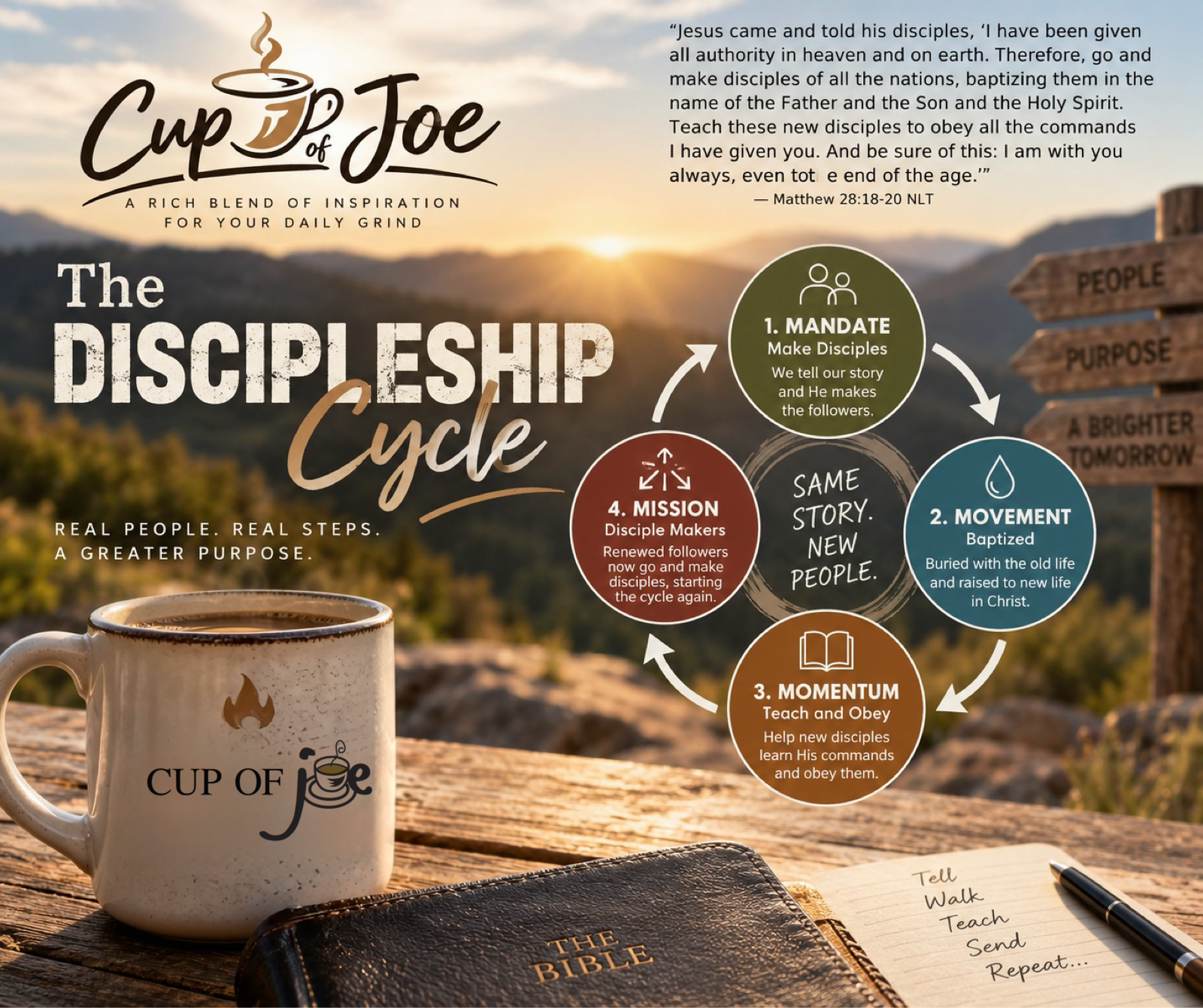
It looks something like this:
Mandate → Movement → Momentum → Mission → Mandate
And then it starts all over again.
MANDATE: Make Disciples
“Therefore, go and make disciples of all the nations…”
There is our mandate.
Notice Jesus didn’t simply say, “Go get people to attend something.” He said to make disciples.
A disciple is a follower.
That takes some of the pressure off us because we don’t have the power to change anyone’s heart. God does that.
Our responsibility is to go.
We tell our story. We share what Jesus has done in our lives. We love people. We serve people. We introduce people to the Jesus who changed us.
I can tell someone about Jesus, but I cannot make that person believe. I can share my story, but I cannot transform a heart.
We tell the story. Jesus makes the follower.
That’s discipleship.
It often begins with one person simply telling another person, “Let me tell you what Jesus has done for me.”
MOVEMENT: From Old Life to New Life
Jesus continues:
“…baptizing them in the name of the Father and the Son and the Holy Spirit.”
Something has happened.
The person who was introduced to Jesus has chosen to follow Him, and now there is movement.
Baptism gives us a beautiful picture of what has taken place. We go beneath the water, symbolically burying the old life, and we come out of the water identifying with a new life in Christ.
The old is buried.
The new is raised.
Following Jesus isn’t simply adding a little religion to the life we already had. Jesus begins changing who we are from the inside out.
That’s movement.
We move from death to life, from our way to His way, from simply knowing about Jesus to actually following Jesus.
And baptism says publicly, “My life belongs to Him.”
But coming out of the water isn’t the end of discipleship.
In many ways, it’s just the beginning.
MOMENTUM: Learning to Live Like Jesus
Jesus then says:
“Teach these new disciples to obey all the commands I have given you.”
I love that Jesus didn’t say simply, “Teach them My commands.”
He said to teach them to obey His commands.
There is a big difference between knowing what Jesus said and building your life around what Jesus said.
That’s where momentum begins.
The new creation begins learning a new way to live.
We learn to hear God.
We learn to trust His Word.
We learn to recognize His direction.
And then we learn to obey.
Sometimes we get it right. Sometimes we don’t. Sometimes growth happens quickly, and sometimes God works on an area of our lives for years.
But we keep moving.
Discipleship isn’t about accumulating biblical information. It’s about transformation.
The Word we hear begins changing the life we live.
We aren’t just learning about Jesus.
We are learning to live like Jesus.
That’s spiritual momentum.
MISSION: The Disciple Becomes a Disciple Maker
And this is where the cycle becomes beautiful.
Eventually, the person who was reached becomes someone who reaches.
The person who was taught begins teaching.
The person who heard someone’s story now has a story of their own.
Think about it.
Someone told you about Jesus.
You believed.
Your old life was buried and you were raised to new life.
You began learning His Word.
You learned to hear Him, trust Him and obey Him.
And somewhere along the way you realize:
I have a story to tell too.
That’s mission.
Jesus never intended discipleship to stop with us.
What God puts into us eventually needs to flow through us.
So we circle right back to where we started.
Go and make disciples.
The mission becomes the mandate again.
AND THE CYCLE CONTINUES
Mandate: Go and make disciples.
Movement: The old life is buried and a new life begins in Christ.
Momentum: Learn His Word, hear His voice, trust Him and obey.
Mission: Take what Jesus has done in you and share it with someone else.
Then…
Mandate: Go and make disciples.
Again.
And again.
And again.
Maybe that’s one reason Jesus ended these instructions with such an incredible promise:
“And be sure of this: I am with you always, even to the end of the age.”
We don’t carry out the mission alone.
The One who sends us goes with us.
The One who changed our lives is working in the lives of the people around us.
So tell your story.
Love somebody.
Share what Jesus has done for you.
Help someone take their next step.
Then watch what God does.
Because a disciple who makes a disciple who makes another disciple can become a movement that reaches farther than any of us could imagine.
The Gospel came to us on its way to someone else.
Keep it moving.
Fast and Curious
Fasting has been practiced for thousands of years, which means we certainly didn’t invent it. In fact, modern culture may just be rediscovering something people of faith have understood for centuries: sometimes less can actually make room for more.
Fasting has been practiced for thousands of years, which means we certainly didn’t invent it. In fact, modern culture may just be rediscovering something people of faith have understood for centuries: sometimes less can actually make room for more.
We usually think of fasting as simply going without food. And while that’s certainly part of it, biblical fasting has never been just about an empty stomach. It’s about creating space. It’s intentionally stepping away from something our body wants so we can become more attentive to what our spirit needs.
And that makes me curious.
What happens when we intentionally interrupt our normal routine?
Physically, fasting gives us an opportunity to become more aware of our hunger, habits, and relationship with food. Research continues to explore potential benefits associated with different forms of fasting, including changes in metabolic health and cellular processes such as autophagy.
But I think something even more interesting can happen.
When the stomach gets quieter, sometimes the soul gets louder.
Fasting has a way of exposing our appetites. You may start a fast thinking about what you’re giving up, only to discover God showing you what you’ve been holding onto.
Comfort.
Convenience.
Control.
Routine.
Maybe even distraction.
That’s one reason fasting and prayer belong together.
Without prayer, fasting can easily become another diet or exercise in willpower. But when we intentionally connect fasting with prayer, those moments of hunger become reminders.
Instead of simply thinking, I’m hungry, we can allow that feeling to prompt another thought:
I’m hungry for God.
Jesus practiced fasting. Throughout Scripture, people fasted when seeking God, needing direction, facing difficult circumstances, repenting, grieving, and preparing for what God was about to do.
Fasting didn’t manipulate God into responding.
It prepared them to hear Him.
There’s an important difference.
Maybe that’s one of the greatest gifts fasting can give us today. We live surrounded by noise. Notifications. Schedules. Entertainment. Food available almost everywhere and almost anytime. Our culture constantly tells us to satisfy every appetite immediately.
Fasting says something different.
I don’t have to obey every appetite I feel.
That lesson reaches far beyond food.
There is freedom in discovering that your cravings don’t have to control you. There is strength in learning to say no to something good for a season so you can say yes to something greater.
And there is something powerful about taking the moments when you would normally eat and turning them into moments with God.
Pray.
Read Scripture.
Listen.
Reflect.
Ask God what He wants to show you.
You may begin fasting because you’re curious about what it can do for your body and discover God is much more interested in what He wants to do in your heart.
If fasting is new to you, you don’t have to begin with something extreme. Start wisely. Start prayerfully. Consider your health and any medications or medical conditions, and talk with your healthcare professional before attempting longer fasts or significant changes to your eating routine.
Then make the spiritual purpose clear.
What am I seeking God about?
That question changes everything.
Because the goal isn’t simply to see how long you can go without eating.
The goal is to become more aware of the One who sustains you.
Maybe fasting really is a reset button. Not just for our eating habits, but for our priorities. It reminds us that we are more than our appetites and that sometimes stepping away from what normally fills us creates room for God to fill us in a deeper way.
So stay curious.
Listen to your body.
Pay attention to your soul.
And when hunger gets your attention, let it turn your attention toward God.
You might discover that the greatest benefit of fasting isn’t found in what you give up.
It’s found in Who you draw closer to.
Stay Fast and Curious.
Building Relational Trust
Trust doesn’t just happen. It is built, one interaction at a time.
There are some things in life that simply cannot be rushed.
Trust is one of them.
Think about the people you trust most. Chances are, that trust wasn’t created in one conversation, one meeting, or one impressive moment. It was built over time through hundreds of small interactions that told you something important:
“I can count on this person.”
That is the heart of relational trust.
Trust doesn’t just happen. It is built, one interaction at a time.
There are some things in life that simply cannot be rushed.
Trust is one of them.
Think about the people you trust most. Chances are, that trust wasn’t created in one conversation, one meeting, or one impressive moment. It was built over time through hundreds of small interactions that told you something important:
“I can count on this person.”
That is the heart of relational trust.
I once taught a class called Building Relational Trust, and the title itself says something important. Trust requires building. It is part of the daily grind of life at work, at home, at church, and in every relationship we have.
Trust doesn’t just happen. Trust is built through consistent, trustworthy behavior.
Trust Begins on the Inside
Stephen M. R. Covey, in The Speed of Trust, describes trust as something that flows outward, like waves moving across water.
The first wave is self-trust.
Before I can consistently build trust with other people, I have to take a look at whether I trust myself.
Do I do what I say I will do?
Do my actions match my words?
Do I keep my commitments?
Can people count on me?
Covey identifies four elements that contribute to credibility:
Integrity. Do I do what I say?
Intent. Am I genuinely seeking the best for others, or do I have a hidden agenda?
Capabilities. Do I have the skills, knowledge, character, and experience necessary to do what I’ve been called to do?
Results. Does my track record demonstrate that I can actually produce what I promise?
That’s worth thinking about.
You can have great intentions and still fail to deliver. You can have tremendous ability and use it selfishly. You can get impressive results while leaving a trail of damaged relationships behind you.
True credibility requires all four.
And for those of us who follow Jesus, this becomes even more personal. Jesus said we are to love our neighbor as we love ourselves (Mark 12:31).
There is something powerful about getting our own hearts right before we expect to build healthy relationships with everyone else.
What We Do Matters More Than What We Say
Once we begin developing self-trust, the next wave is relationship trust.
This is where trust becomes visible.
People don’t experience our intentions. They experience our behavior.
We can say, “You can trust me,” all day long. But eventually, our behavior will answer the question for us.
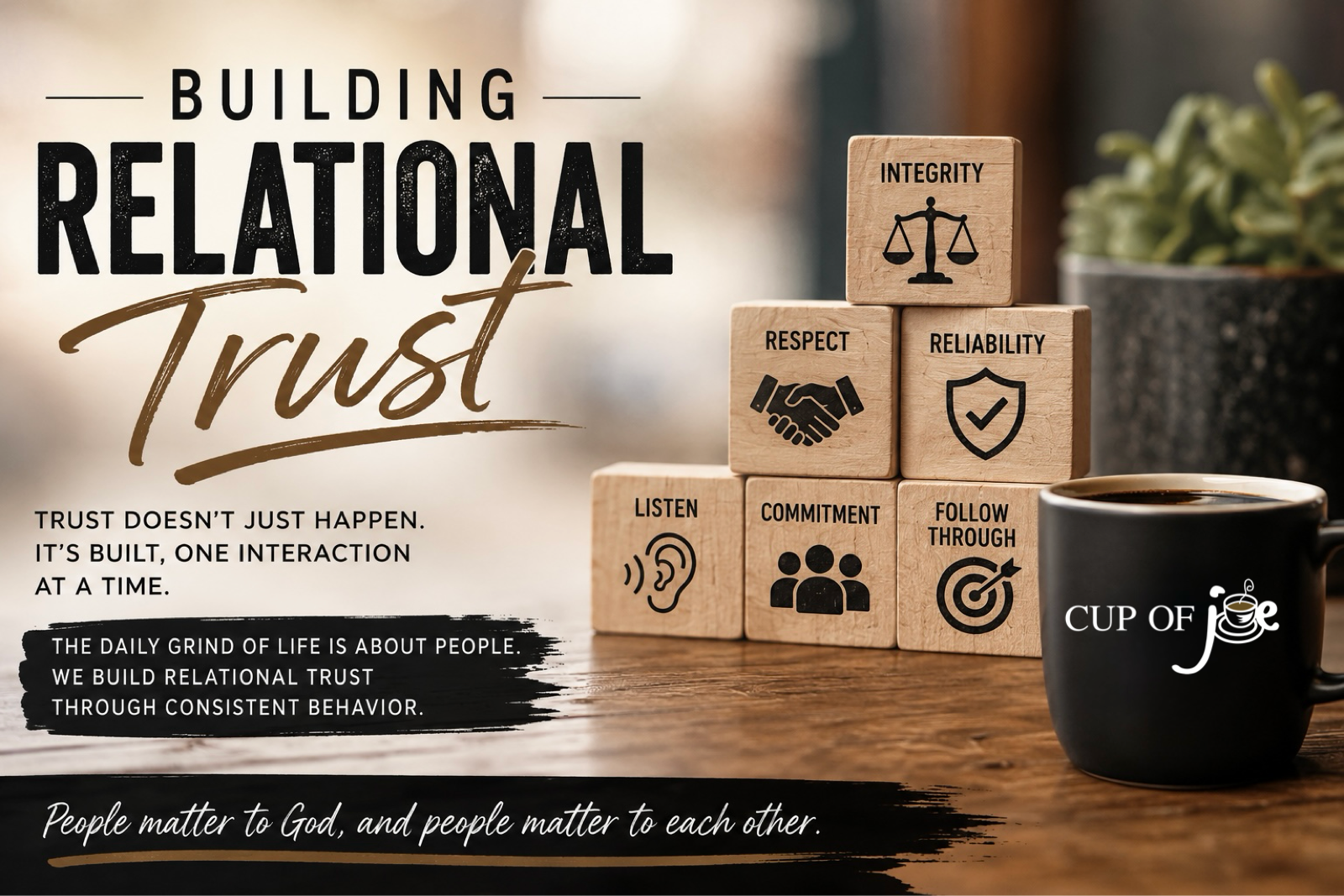
Covey identifies 13 behaviors that build trust. They are simple, but they are not always easy:
Talk straight. Say what you mean and mean what you say.
Show respect. Treat people with dignity, regardless of what they can do for you.
Be transparent. Let people see the real you. Authenticity builds confidence.
Right wrongs. When you make a mistake, own it. Then do what you can to make it right.
Show loyalty. Give credit where credit is due. Celebrate the contribution of others.
Deliver results. Do what you said you would do. Your track record matters.
Get better. Keep learning. Yesterday’s skill set may not be enough for tomorrow’s assignment.
Confront reality. Don’t ignore difficult circumstances simply because they’re uncomfortable.
State expectations. Make sure people know where you’re going before you ask them to help you get there.
Be accountable. Take responsibility for what belongs to you.
Listen first. Sometimes the most trustworthy thing you can do is stop talking and start listening.
Meet commitments. Your word should mean something.
Extend trust. Sometimes someone has to take the first step. Why shouldn’t it be you?
None of these behaviors are complicated.
But they are powerful because trust is accumulated in small deposits.
And unfortunately, it can also be depleted in small withdrawals.
Your Trust Account
I love thinking about trust as an account.
Every interaction gives us an opportunity to make a deposit or a withdrawal.
Keeping your word is a deposit.
Listening is a deposit.
Owning a mistake is a deposit.
Giving someone credit is a deposit.
Telling the truth when the truth is uncomfortable is a deposit.
Breaking a commitment is a withdrawal.
Manipulating someone is a withdrawal.
Blaming others is a withdrawal.
Saying one thing and doing another is a withdrawal.
Eventually, people look at the balance.
They may never say it out loud, but they are asking:
“Can I trust you?”
And here’s the beautiful part. If we’ve made withdrawals, the account isn’t necessarily closed.
We can begin making deposits again.
We can apologize.
We can change.
We can become more consistent.
We can keep our word.
We can listen.
We can choose integrity when nobody is watching.
Trust can be rebuilt.
The Ripple Effect
I’ve had the privilege of spending decades working with people in ministry, business, music, nonprofits, churches, and organizations. I’ve watched God take people into new seasons and new assignments.
Looking back, one thing becomes increasingly clear:
People don’t follow a vision simply because the vision is big. They follow people they trust to carry the vision.
I’ve seen God move me through different seasons of ministry and leadership. Each season required new people, new relationships, and new levels of trust.
That kind of journey doesn’t happen without relational trust.
Trust is the social concrete of every healthy relationship.
And when trust is present, something happens. Communication gets better. Teams become stronger. Conflict becomes healthier. People become more willing to take risks, admit mistakes, grow, and pursue something bigger than themselves.
That’s why trust doesn’t just affect relationships.
Trust affects the future.
Paul gives us a beautiful picture of what can happen when God is at work through people:
“Now to him who is able to do immeasurably more than all we ask or imagine…”
Ephesians 3:20
Imagine what God could do through a family where trust is growing.
Imagine what He could do through a church where people speak the truth in love, extend grace, take responsibility, and genuinely care for one another.
Imagine what He could do through a team where people know they don’t have to protect themselves because they know they can trust each other.
Maybe building relational trust isn’t about changing everyone around us.
Maybe it starts with asking a much simpler question:
“What can I do today that will make me a more trustworthy person?”
Because trust doesn’t happen all at once.
It happens one conversation at a time.
One commitment at a time.
One apology at a time.
One act of integrity at a time.
One relationship at a time.
Trust is built in the daily grind. And every day, we get another opportunity to make a deposit.
When Plans Change
We all make plans.
From the time we are young, we imagine what our lives will look like. We dream about our career, relationships, family, home, and future. There’s nothing wrong with making plans. Proverbs 16:9 says:
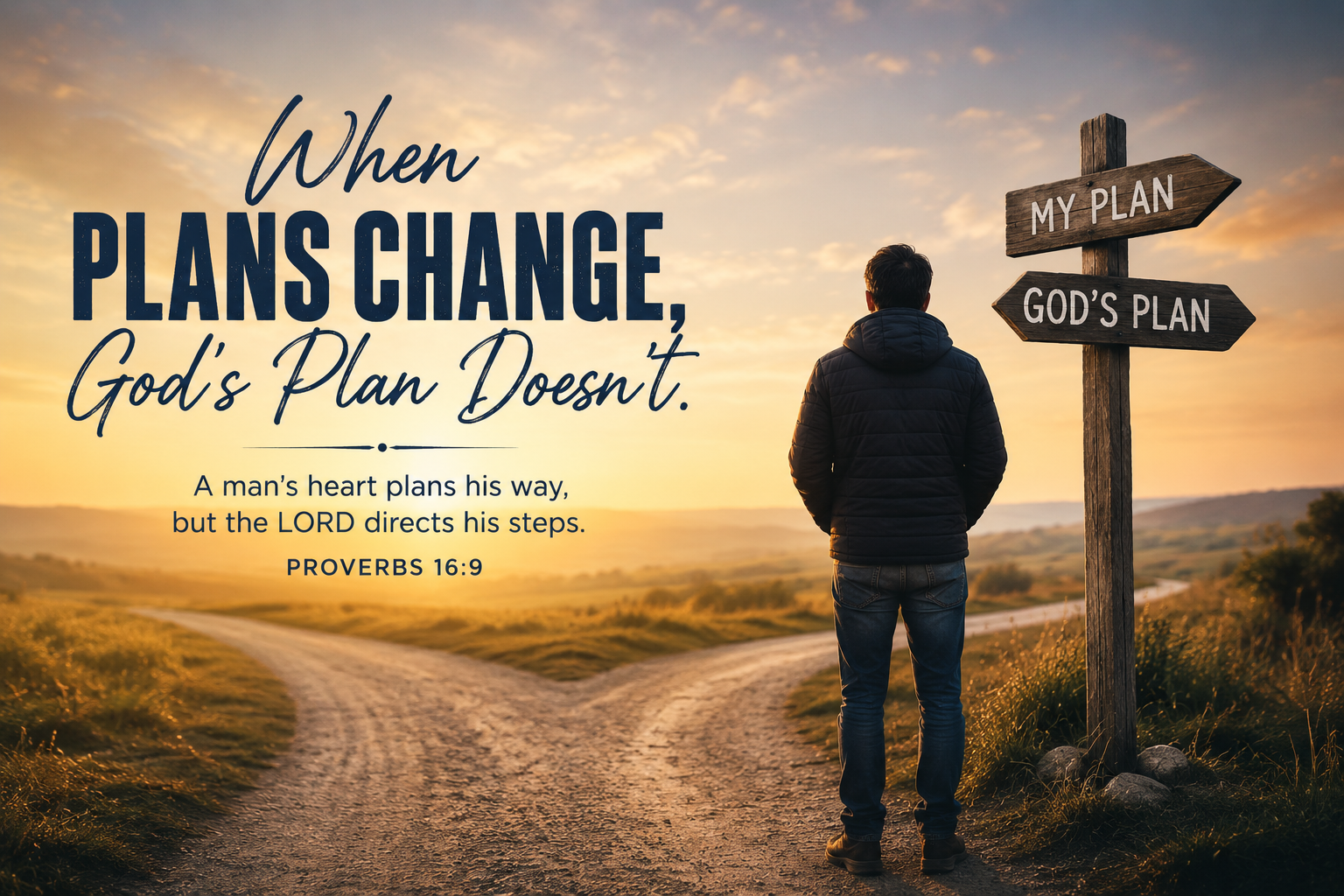
“A man’s heart plans his way, but the LORD directs his steps.”
We all make plans.
From the time we are young, we imagine what our lives will look like. We dream about our career, relationships, family, home, and future. There’s nothing wrong with making plans. Proverbs 16:9 says:
“A man’s heart plans his way, but the LORD directs his steps.”
The problem comes when we begin to believe our plan is the plan.
Sometimes life doesn’t turn out the way we imagined. A relationship changes. A dream doesn’t happen. A career takes an unexpected turn. Something we never saw coming suddenly becomes part of our story.
When that happens, we can wonder, “What happened to God’s plan for my life?”
But perhaps the better way to see it is this:
Our circumstances may change, but God’s plan doesn’t.
We may have gotten ahead of God with our expectations. We may have assumed we knew how everything was supposed to work out. But God sees what we cannot see. He knows where the next step leads, even when we don’t.
That’s why Proverbs 16:3 says:
“Commit to the LORD whatever you do, and your plans will succeed.”
To commit means to entrust something to someone else’s care.
That’s what God asks us to do with our lives. Entrust Him with the plans. Entrust Him with the disappointments. Entrust Him with the things we don’t understand.
You don’t have to know how everything will work out.
You just have to know who is directing your steps.
What plans have you been holding so tightly that you need to place them back in God’s hands?
Today’s Prayer
Lord, help me make plans without holding them so tightly that I forget You are directing my steps. When life doesn’t go the way I expected, help me trust that Your plan is still good. I commit my plans, my dreams, and my future to You today. Amen.
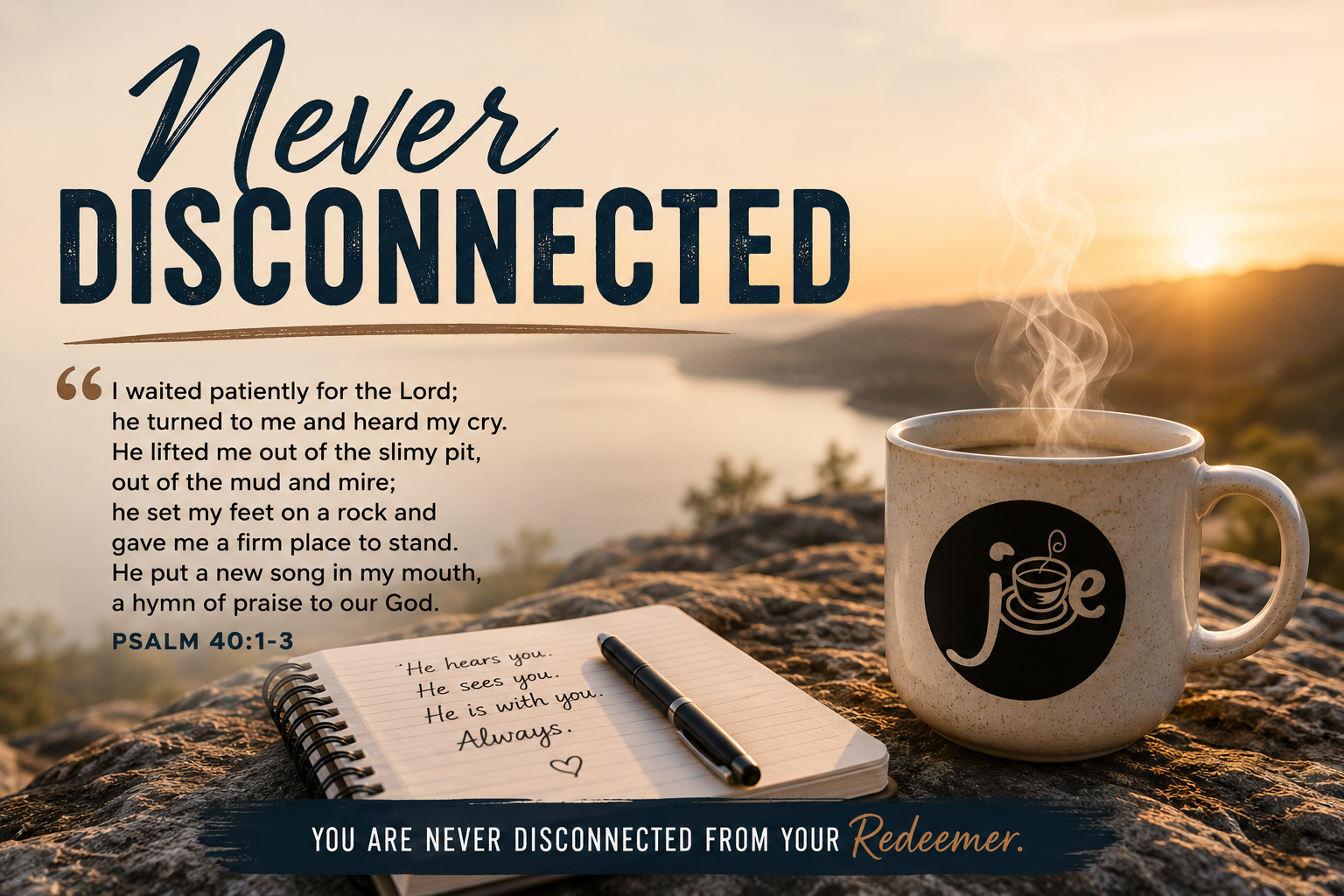
Never Disconnected
There are seasons when life feels strangely quiet.
Your routine changes. The conversations become fewer. The familiar faces aren’t around like they used to be. You may find yourself spending more time alone than you expected, and somewhere along the way, a thought can creep in:
Does anybody see me? Does anybody hear me?
There are seasons when life feels strangely quiet.
Your routine changes. The conversations become fewer. The familiar faces aren’t around like they used to be. You may find yourself spending more time alone than you expected, and somewhere along the way, a thought can creep in:
Does anybody see me? Does anybody hear me?
Psalm 40 speaks directly into those moments:
“I waited patiently for the Lord; he turned to me and heard my cry.
He lifted me out of the slimy pit, out of the mud and mire;
he set my feet on a rock and gave me a firm place to stand.
He put a new song in my mouth, a hymn of praise to our God.”
What encouraged me today wasn’t just that David waited. It was what happened while he waited.
God heard him.
When you are in a season with limited interaction, it can feel like you’re disconnected from everything and everyone. It feels different. The normal rhythms of life aren’t so normal anymore.
But here’s the truth I want you to hold onto today:
You may feel disconnected from your routine, but you are never disconnected from your Redeemer.
God hears you.
God sees you.
God is still working.
And Psalm 40 reminds us of what He does when we cry out to Him.
He lifts us up.
David says, “He lifted me out of the slimy pit, out of the mud and mire.”
Maybe you’re feeling down today. Maybe circumstances have left you feeling stuck, overlooked, or uncertain about what comes next.
God doesn’t leave you in the pit.
He reaches down and lifts you up. He brings you out and draws you into His presence.
He gives us a safe place to stand.
“He set my feet on a rock and gave me a firm place to stand.”
I love that picture.
The circumstances around us may still be uncertain, but God provides stability in the middle of uncertainty. The ground may feel like it’s shifting, but He is not shifting.
You can stand on Him.
He puts a new song in our mouths.
This may be my favorite part.
God doesn’t just change our circumstances. Sometimes He changes what comes out of our mouths while we’re still walking through them.
A new song.
Praise instead of problems.
Faith instead of fear.
Worship instead of worry.
The situation may not have changed yet, but something has changed inside of us.
And people notice.
Your faithfulness in a difficult season may become someone else’s reason to trust God. Your decision to keep praising when life gives you plenty of reasons to complain may become a testimony that points somebody else toward Jesus.
So let me encourage you today:
God IS listening.
He hears YOU.
He sees YOU.
He knows where you are.
And even when you feel disconnected from the people and routines around you, you are never disconnected from your Redeemer.
Keep waiting.
Keep standing.
Keep praising.
There is a new song coming.
And somebody may find their way to Jesus because they heard you singing it.

More Cheese than Holes
Early this morning, I couldn’t get an unusual picture out of my mind. It wasn’t a sunrise, a mountain, or an open Bible. It was a piece of Swiss cheese.
Early this morning, I couldn’t get an unusual picture out of my mind. It wasn’t a sunrise, a mountain, or an open Bible. It was a piece of Swiss cheese.
Strange, I know.
But sometimes God uses the most ordinary things to reveal extraordinary truths.
As I looked at that piece of cheese, I noticed what everyone notices first: the holes. Then I sensed the Lord gently say, “Look closer.”
That’s when it hit me.
When you hold Swiss cheese close to your face, all you can see are the holes. In fact, if you’re looking through one of them, it can seem like there’s nothing there at all.
Isn’t that how life feels sometimes?
When disappointment is right in front of us… when grief, unanswered prayers, financial pressure, or broken relationships fill our vision… it’s easy to believe our whole life is nothing but empty spaces. We become so focused on what’s missing that we overlook everything God has already placed in our hands.
But perspective changes everything.
Step back.
Now look again.
The holes are real. They haven’t disappeared. The pain happened. The loss was significant. Life may have landed a few hard blows that left their mark on your heart.
Yet the holes are not the whole story.
There’s far more cheese than hole.
Maybe today you’ve been staring through the opening created by disappointment. You’ve convinced yourself there’s no substance left, no hope ahead, nothing good to hold onto.
Can I encourage you?
Take one step back.
You’ll begin to see God’s faithfulness surrounding the places that hurt. You’ll notice His provision where you thought there was only lack. You’ll remember the people who love you, the prayers He’s answered, the strength He’s supplied, and the grace that has carried you farther than you ever imagined.
The scars may still be there, but so is the goodness of God.
Scripture reminds us, “Taste and see that the Lord is good; blessed is the one who takes refuge in him” (Psalm 34:8). Sometimes we have to stop looking through the hole long enough to see the abundance that has been there all along.
Today, if all you can see is what’s missing, ask the Lord to give you His perspective.
I think you’ll discover what I did.
There is far more cheese than hole.
Reflection:
What “hole” has captured your attention lately? What evidence of God’s faithfulness have you overlooked because it has been sitting just outside your focus?
Prayer:
Father, thank You for reminding me that my life is not defined by what is missing, but by Your presence and Your faithfulness. Help me step back and see my life through Your eyes. Give me gratitude for what remains, hope for what is ahead, and confidence that You have never left me. Amen.