

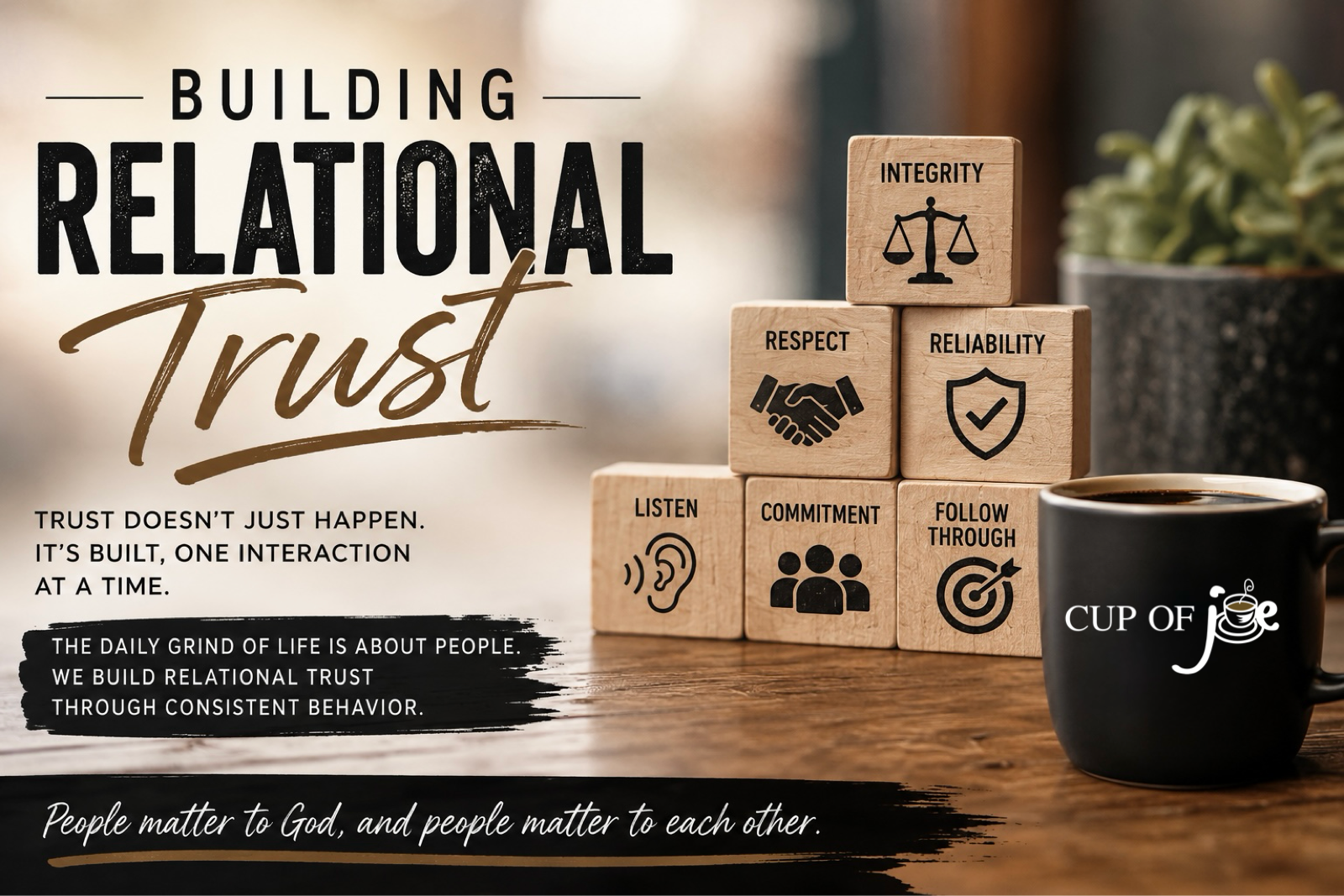
Building Relational Trust
Trust doesn’t just happen. It is built, one interaction at a time.
There are some things in life that simply cannot be rushed.
Trust is one of them.
Think about the people you trust most. Chances are, that trust wasn’t created in one conversation, one meeting, or one impressive moment. It was built over time through hundreds of small interactions that told you something important:
“I can count on this person.”
That is the heart of relational trust.
Trust doesn’t just happen. It is built, one interaction at a time.
There are some things in life that simply cannot be rushed.
Trust is one of them.
Think about the people you trust most. Chances are, that trust wasn’t created in one conversation, one meeting, or one impressive moment. It was built over time through hundreds of small interactions that told you something important:
“I can count on this person.”
That is the heart of relational trust.
I once taught a class called Building Relational Trust, and the title itself says something important. Trust requires building. It is part of the daily grind of life at work, at home, at church, and in every relationship we have.
Trust doesn’t just happen. Trust is built through consistent, trustworthy behavior.
Trust Begins on the Inside
Stephen M. R. Covey, in The Speed of Trust, describes trust as something that flows outward, like waves moving across water.
The first wave is self-trust.
Before I can consistently build trust with other people, I have to take a look at whether I trust myself.
Do I do what I say I will do?
Do my actions match my words?
Do I keep my commitments?
Can people count on me?
Covey identifies four elements that contribute to credibility:
Integrity. Do I do what I say?
Intent. Am I genuinely seeking the best for others, or do I have a hidden agenda?
Capabilities. Do I have the skills, knowledge, character, and experience necessary to do what I’ve been called to do?
Results. Does my track record demonstrate that I can actually produce what I promise?
That’s worth thinking about.
You can have great intentions and still fail to deliver. You can have tremendous ability and use it selfishly. You can get impressive results while leaving a trail of damaged relationships behind you.
True credibility requires all four.
And for those of us who follow Jesus, this becomes even more personal. Jesus said we are to love our neighbor as we love ourselves (Mark 12:31).
There is something powerful about getting our own hearts right before we expect to build healthy relationships with everyone else.
What We Do Matters More Than What We Say
Once we begin developing self-trust, the next wave is relationship trust.
This is where trust becomes visible.
People don’t experience our intentions. They experience our behavior.
We can say, “You can trust me,” all day long. But eventually, our behavior will answer the question for us.
Covey identifies 13 behaviors that build trust. They are simple, but they are not always easy:
Talk straight. Say what you mean and mean what you say.
Show respect. Treat people with dignity, regardless of what they can do for you.
Be transparent. Let people see the real you. Authenticity builds confidence.
Right wrongs. When you make a mistake, own it. Then do what you can to make it right.
Show loyalty. Give credit where credit is due. Celebrate the contribution of others.
Deliver results. Do what you said you would do. Your track record matters.
Get better. Keep learning. Yesterday’s skill set may not be enough for tomorrow’s assignment.
Confront reality. Don’t ignore difficult circumstances simply because they’re uncomfortable.
State expectations. Make sure people know where you’re going before you ask them to help you get there.
Be accountable. Take responsibility for what belongs to you.
Listen first. Sometimes the most trustworthy thing you can do is stop talking and start listening.
Meet commitments. Your word should mean something.
Extend trust. Sometimes someone has to take the first step. Why shouldn’t it be you?
None of these behaviors are complicated.
But they are powerful because trust is accumulated in small deposits.
And unfortunately, it can also be depleted in small withdrawals.
Your Trust Account
I love thinking about trust as an account.
Every interaction gives us an opportunity to make a deposit or a withdrawal.
Keeping your word is a deposit.
Listening is a deposit.
Owning a mistake is a deposit.
Giving someone credit is a deposit.
Telling the truth when the truth is uncomfortable is a deposit.
Breaking a commitment is a withdrawal.
Manipulating someone is a withdrawal.
Blaming others is a withdrawal.
Saying one thing and doing another is a withdrawal.
Eventually, people look at the balance.
They may never say it out loud, but they are asking:
“Can I trust you?”
And here’s the beautiful part. If we’ve made withdrawals, the account isn’t necessarily closed.
We can begin making deposits again.
We can apologize.
We can change.
We can become more consistent.
We can keep our word.
We can listen.
We can choose integrity when nobody is watching.
Trust can be rebuilt.
The Ripple Effect
I’ve had the privilege of spending decades working with people in ministry, business, music, nonprofits, churches, and organizations. I’ve watched God take people into new seasons and new assignments.
Looking back, one thing becomes increasingly clear:
People don’t follow a vision simply because the vision is big. They follow people they trust to carry the vision.
I’ve seen God move me through different seasons of ministry and leadership. Each season required new people, new relationships, and new levels of trust.
That kind of journey doesn’t happen without relational trust.
Trust is the social concrete of every healthy relationship.
And when trust is present, something happens. Communication gets better. Teams become stronger. Conflict becomes healthier. People become more willing to take risks, admit mistakes, grow, and pursue something bigger than themselves.
That’s why trust doesn’t just affect relationships.
Trust affects the future.
Paul gives us a beautiful picture of what can happen when God is at work through people:
“Now to him who is able to do immeasurably more than all we ask or imagine…”
Ephesians 3:20
Imagine what God could do through a family where trust is growing.
Imagine what He could do through a church where people speak the truth in love, extend grace, take responsibility, and genuinely care for one another.
Imagine what He could do through a team where people know they don’t have to protect themselves because they know they can trust each other.
Maybe building relational trust isn’t about changing everyone around us.
Maybe it starts with asking a much simpler question:
“What can I do today that will make me a more trustworthy person?”
Because trust doesn’t happen all at once.
It happens one conversation at a time.
One commitment at a time.
One apology at a time.
One act of integrity at a time.
One relationship at a time.
Trust is built in the daily grind. And every day, we get another opportunity to make a deposit.
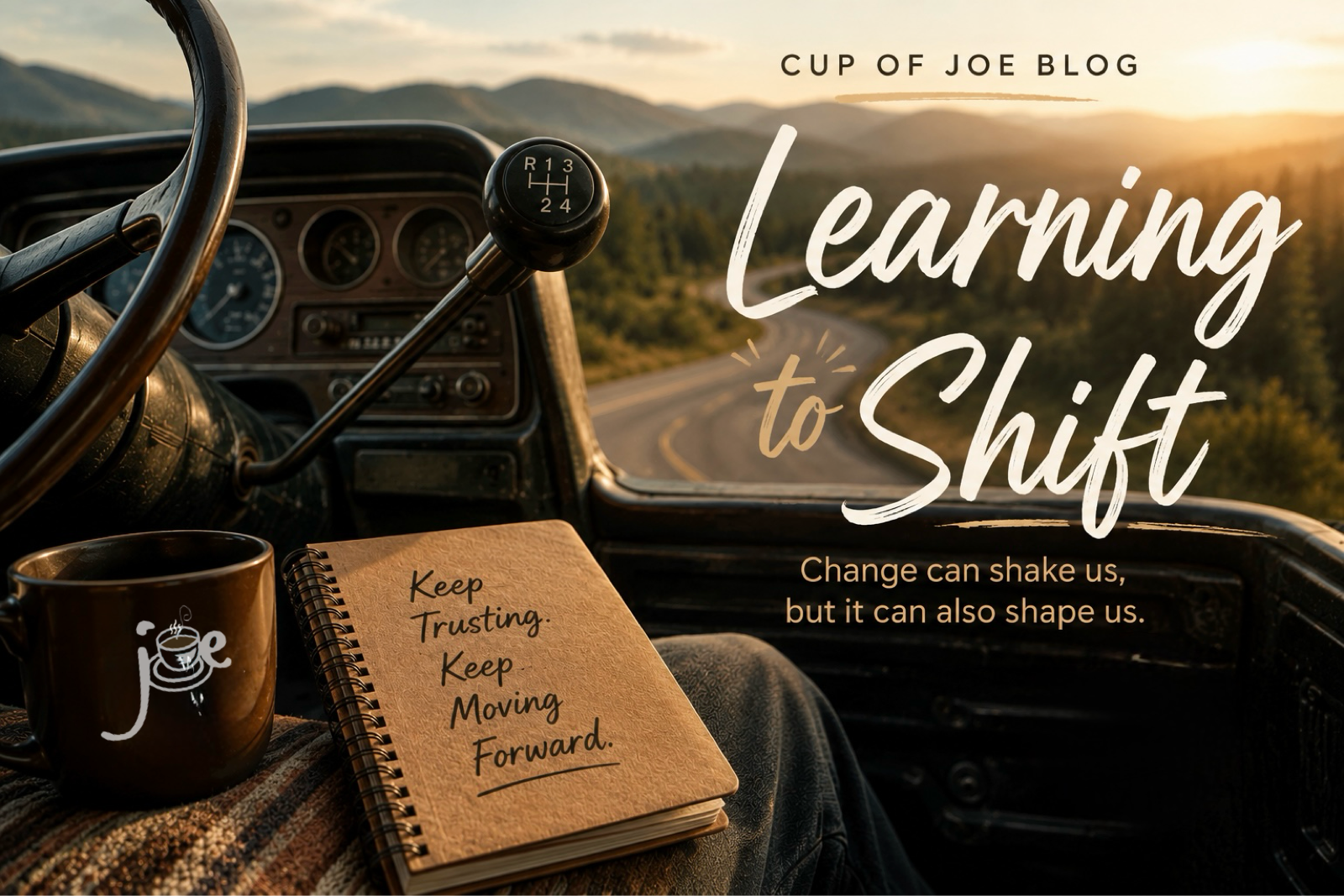
Learning to Shift
Have you ever noticed that some seasons of life feel like you're trying to drive a vehicle you've never driven before?
When I graduated from college and moved from Oklahoma to Texas, someone graciously loaned me an old pickup truck to make the trip. There was just one small problem.
It had a manual transmission.
Not the kind on the floor either. This one had the gear shift on the steering column. I had never driven anything like it.
Suddenly, I wasn't just steering and pressing the gas pedal. I had to learn where every gear was, coordinate both feet, find the clutch at just the right moment, and somehow keep the truck moving without stalling. Every mistake announced itself with an awful grinding noise that sounded like I had just scraped a brick across the hood. The truck shook. I shook. It felt like everything was about to fall apart.
Eventually, though, something happened.
The shifting became smoother. The gears began to connect. The truck moved forward.
Life has a way of feeling like that truck.
There are seasons when everything seems to shift at once. A job changes. Relationships change. Church changes. Family dynamics change. Plans you carefully mapped out suddenly take a detour you never expected.
Those moments can feel unsettling because we're trying to figure out which "gear" we're supposed to be in while everything around us keeps moving.
The truth is, change is rarely comfortable.
Everyone experiences transition differently. Some embrace it. Others resist it. Some need time to process, while others want immediate answers. That's why seasons of change often feel messy. They're filled with emotions, opinions, uncertainty, and questions that don't always have quick solutions.
I've learned that not every problem during a transition gets solved overnight. Sometimes the goal isn't perfection. It's simply continuing to move forward.
Forward is still forward, even if it's slower than you'd like.
One of the greatest gifts we can give during uncertain seasons is our steady presence. People don't always need someone with all the answers. They need someone who brings hope instead of fear, encouragement instead of criticism, and calm instead of chaos.
When you encourage someone, you literally put courage back into them.
When you choose empathy over judgment, you remind people they aren't walking through the uncertainty alone.
When you're available to listen, serve, or simply stand beside someone, you become part of God's steady hand during an unsteady season.
The Apostle Paul reminds us in Galatians 6:9, "Let us not become weary in doing good, for at the proper time we will reap a harvest if we do not give up."
Maybe today feels like you're grinding gears.
Maybe you're wondering if you'll ever figure out this new season.
You will.
God has a way of teaching us how to shift. What feels awkward today often becomes second nature tomorrow. The shaking won't last forever. The grinding eventually gives way to progress.
So don't fear the transition.
Lean into it.
Trust the One who knows every curve in the road ahead.
Because even when life feels shaky, God is still moving you forward.
Cup of Joe to Go
The smoothest drivers weren't born knowing how to shift gears. They learned through the grinding. The same is true in life. Trust God through the transition, keep moving forward, and you'll discover that every shift has been preparing you for the road ahead.