

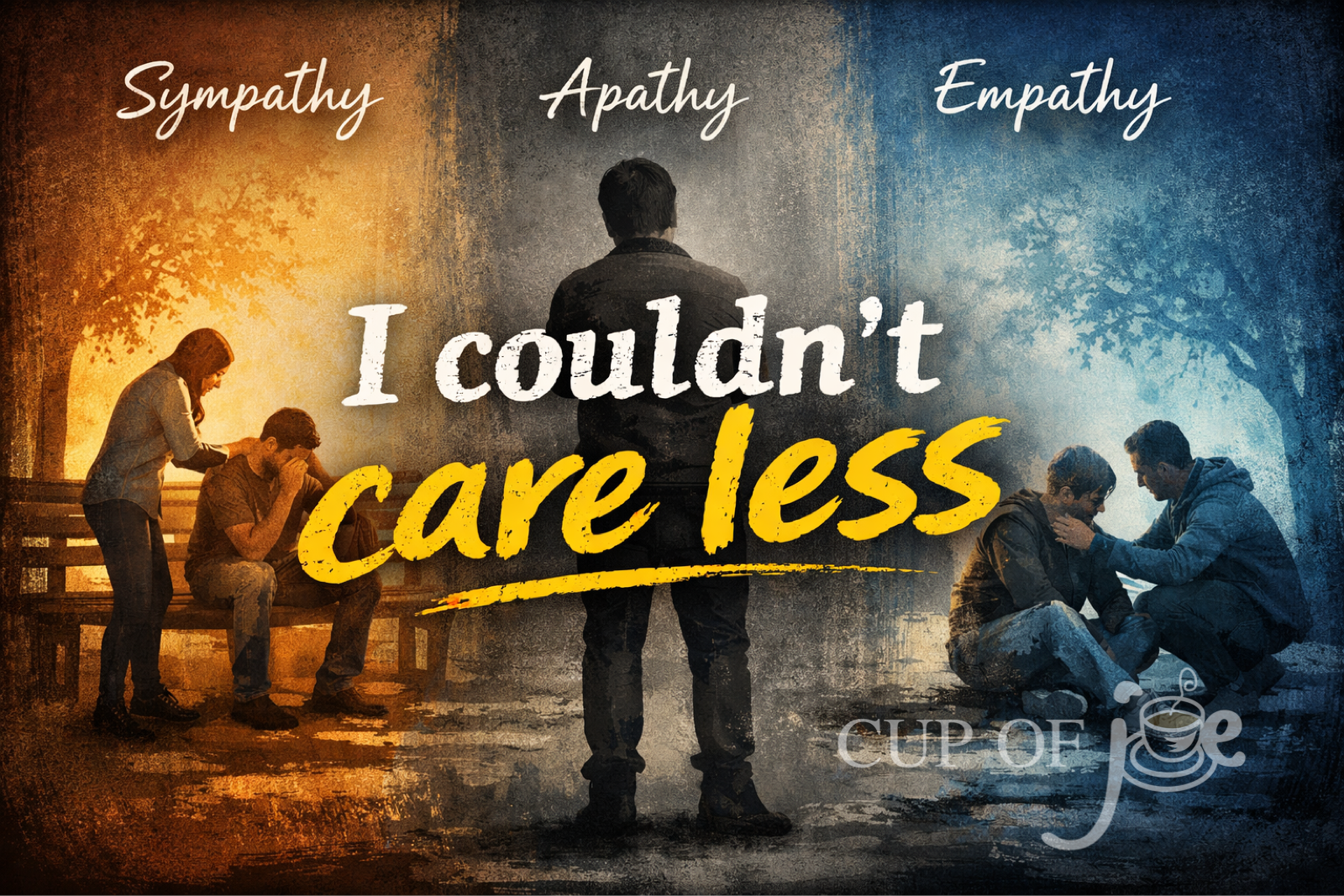
I Couldn’t Care Less
I bet at some point in your life, you’ve heard this phrase come out of your mouth or a friends-“I couldn’t care less.” It means there is no more care in me as it relates to the situation. I’ve even heard some say, “I could care less.” Perhaps by mistake because that would mean that they really do care… a little. 😊 I’m sure all of us wish that we could be a bit more caring.
Scripture says,
“Rejoice with those who rejoice; mourn with those who mourn.”
Romans 12:15
There is a pathway I have noticed in my own life that you may relate to. It includes sympathy, apathy and empathy. And each of these is different.
Here is what I think happens. Most of us start with sympathy.
When someone shares a burden, we feel it for a moment. We offer kind words. We acknowledge their struggle. Sympathy notices pain and says, “I’m sorry you’re going through that.” It’s a good place to begin.
But life has a way of stretching our emotional capacity.
The longer we live, the more suffering we see. Another diagnosis. Another broken relationship. Another crisis. Another prayer request. And sometimes, without realizing it, sympathy slowly fades into something else.
Apathy.
It’s not that we stop caring entirely. It’s that our hearts get tired. Compassion fatigue sets in. We hear about another problem and something inside us quietly says, I just can’t carry one more thing.
Apathy is often the heart’s attempt to protect itself.
But God invites us into something deeper than either sympathy or apathy. He calls us to empathy.
Empathy does more than acknowledge someone’s pain. It chooses to enter into it with them. Not to fix everything. Not to carry every burden alone. But to stand close enough to say, “You’re not walking through this by yourself.”
Jesus modeled this perfectly. He didn’t stay distant from human suffering. He stepped into it. He wept with grieving friends. He touched lepers no one else would touch. He carried burdens others tried to ignore.
Empathy is compassion that has learned how to stay present.
It sees the pain.
It resists the temptation to turn away.
And it walks alongside people with grace and strength.
Today you may feel the pull toward apathy. That happens to all of us at times. When it does, ask God to soften your heart again.
Not so you carry the weight of the whole world. But so you can carry the heart of Christ into the world.
Sometimes the greatest gift we give someone is simply our presence.
That’s empathy.

Same Spirit. Different Gifts.
Have you ever noticed how easy it is to compare gifts?
One person can teach with clarity.
Another leads with bold faith.
Someone else serves quietly behind the scenes and never asks for credit.
And if we are not careful, comparison can turn gratitude into insecurity.
Paul writes in 1 Corinthians 12:4–7 that there are different kinds of gifts, different kinds of service, and different kinds of workings. But the same Spirit. The same Lord. The same God at work in all of them.
Different expressions.
Same Source.
That means your gift is not random. It is not accidental. It is not less spiritual because it looks different from someone else’s.
The Spirit distributes. The Lord directs. God works.
And then Paul gives us the anchor point: each manifestation of the Spirit is given for the common good.
Not for applause.
Not for platform.
Not for personal branding.
For the good of others.
In a world obsessed with visibility, the Kingdom is focused on usefulness.
The gift of encouragement matters just as much as the gift of preaching.
Administration is as sacred as prophecy.
Serving coffee with joy can be as Spirit-led as leading worship.
Because it is the same God at work.
That changes how we see ourselves. It also changes how we see others.
When someone else shines, we do not shrink. We celebrate. Their strength is not competition. It is completion. The Body functions best when every part embraces its role.
And here is the beautiful tension: the Spirit gives the gift, but we steward it.
We grow it.
We exercise it.
We offer it back to God daily.
The question is not, Do I have a gift? The question is, am I using what He has given me for the common good?
Today, resist comparison. Reject insecurity. Release your gift.
You were entrusted with it on purpose.
Same Spirit.
Different Gifts.
And through you, someone else gets to experience His goodness.

No Confidence
“This is the confidence we have in approaching God: that if we ask anything according to his will, he hears us. And if we know that he hears us, whatever we ask, we know that we have what we asked of him.”
1 John 5:14–15
Imagine a CEO walking into the boardroom on a Monday morning only to be handed a formal letter from his own employees. It reads: Vote of No Confidence.
They do not trust his leadership.
They question his decisions.
They doubt his ability to guide the company forward.
The vote may not remove him immediately, but it sends a clear message: We do not believe in you.
Now let that sink in spiritually.
How often do we treat God like that CEO?
We would never say it out loud. We sing about His faithfulness. We preach about His sovereignty. We quote verses about His goodness. Yet when pressure rises, when prayers feel delayed, when outcomes do not align with our expectations, our anxiety and self-reliance can quietly declare, “Lord, I am not sure You’ve got this.”
That is a subtle vote of no confidence.
John writes with clarity and reassurance: This is the confidence we have in approaching God… Not hesitation. Not suspicion. Not guarded uncertainty. Confidence.
Biblical confidence is not arrogance. It is settled trust in the character of God.
John anchors that confidence in two powerful truths:
First, He hears us.
Not might hear. Not occasionally hears. He hears. The Creator of the universe is attentive to the voice of His children. Every prayer whispered in a hospital room. Every cry uttered in a car alone. Every burden carried into the quiet of early morning. He hears.
Second, He answers according to His will.
This is where faith matures. Confidence grows when we understand that God’s will is not a barrier to our prayers but the foundation of them. His will flows from perfect wisdom, complete knowledge, and unfailing love.
A CEO might miscalculate market trends.
A leader might lack crucial information.
An executive might act from ego or fear.
God never does.
When we rush ahead of Him, manipulate circumstances, or spiral in worry, we are functionally casting a vote of no confidence in His leadership. We are saying, “I need to take control because I am not sure You will.”
But John invites us back into settled assurance. If He hears us, and if He acts according to His will, then the outcome is already in trustworthy hands. Confidence in prayer is rooted in confidence in who He is.
You do not have to pressure God.
You do not have to convince Him.
You do not have to manage the universe on His behalf.
You simply align your heart with His will and ask.
Real confidence says, “Father, I trust Your timing more than my urgency. I trust Your wisdom more than my understanding. I trust Your outcome more than my preference.”
There is no vote of no confidence in heaven. The throne is not up for reelection. The leadership of God is not under review.
And that is good news.
Today, before anxiety drafts its own letter of doubt, return to what John reminds us. Approach Him with confidence. Ask boldly. Rest fully. Trust completely.
The One who hears you is the One who holds you.