

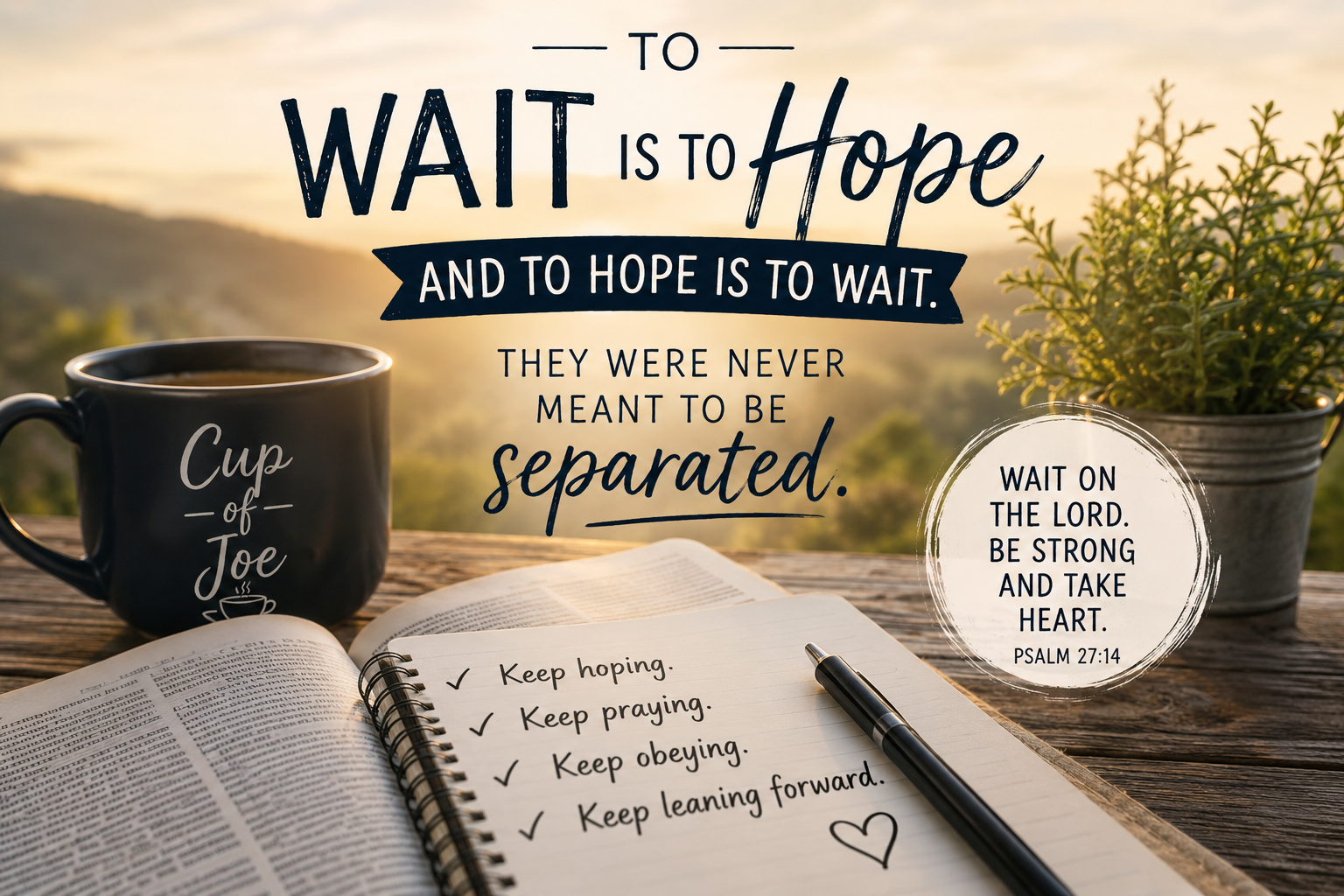
To Wait is to Hope
Waiting Isn’t What You Think It Is
Grab your coffee and sit with me for a minute. Today’s thought may change the way you see the seasons when life feels delayed.
Most of us think of waiting as passive. We picture a waiting room, a long line, or watching the clock until something finally happens. Waiting can feel like life has been placed on pause until the answer arrives.
But the Bible gives us a much richer picture.
In the Hebrew Scriptures, the word often translated as “wait” is qavah. It can also be translated as “hope.” That is not an accident. It reveals that biblical waiting is not simply sitting still. It is living with expectation, trust, and a heart that remains engaged with God.
Waiting and hoping are connected.
The word qavah carries the idea of being stretched or pulled tight, like a rope under tension. It is the picture of someone leaning forward, not checking out. It is not passive resignation. It is active expectation.
Psalm 27:14 says:
“Wait for the Lord; be strong and take heart and wait for the Lord.”
Notice what sits in the middle of that verse: “Be strong and take heart.” God is not calling us to become numb while we wait. He is inviting us to strengthen our hearts in His presence.
Isaiah 40:31 says:
“But those who hope in the Lord will renew their strength. They will soar on wings like eagles; they will run and not grow weary, they will walk and not be faint.”
The same Hebrew root is often translated here as “hope.” And look at the result: soaring, running, walking. Hope produces movement. It renews strength. It keeps us moving forward even when the answer has not yet arrived.
Psalm 130:5 adds another layer:
“I wait for the Lord, my whole being waits, and in his word I put my hope.”
This is not a bored shrug while time passes. This is a whole-person posture of trust. The psalmist is waiting, but he is also anchoring his hope in the Word of God.
That is the shift we need to make.
When we see waiting as passive, we can begin to disengage. We pray less. We trust less. We stop expecting. We simply try to wait it out.
But waiting on God is not doing nothing.
Waiting on God means continuing to obey when the path is unclear. It means continuing to pray when the answer seems delayed. It means continuing to strengthen your heart when discouragement tries to settle in.
Think about a farmer waiting for a harvest. He does not plant the seed and then sit on the porch doing nothing. He waters. He weeds. He tends the field. He works with confidence that growth is taking place, even when he cannot yet see it.
That is biblical waiting.
Maybe you are waiting for healing, provision, direction, restoration, or a breakthrough. God is not asking you to freeze in place. He is inviting you to hope actively.
Keep leaning forward.
Keep tending the field.
Keep praying.
Keep obeying.
Keep your heart engaged.
Because in the language of Scripture, to wait is to hope, and to hope is to wait. They were never meant to be separated.
Until next time, keep your cup full and your heart hopeful.
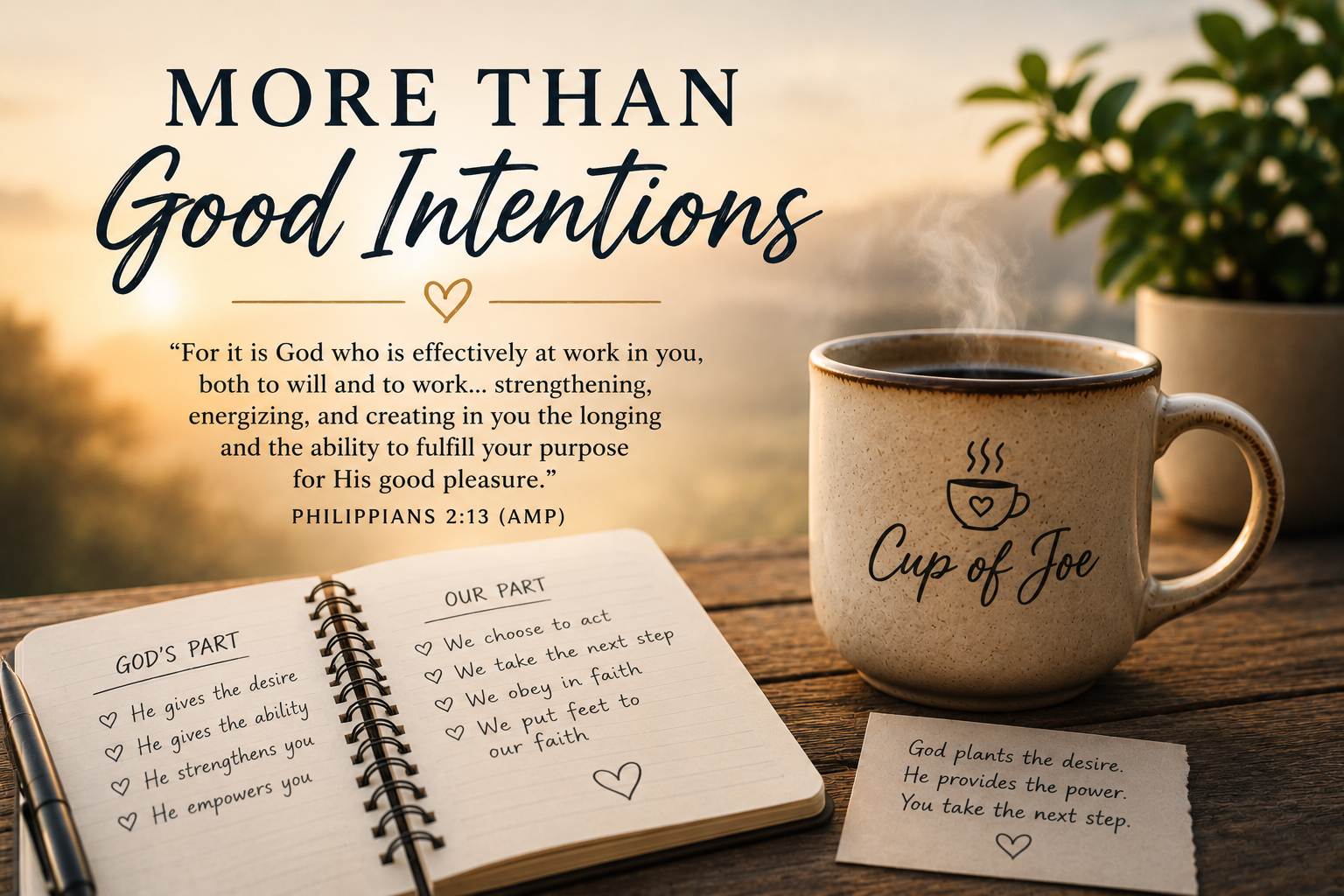
Good Intentions
Have you ever said, "I really want to..."
I want to pray more.
I want to be more patient.
I want to forgive.
I want to serve.
I want to become the person God created me to be.
Good intentions are a great starting point, but they were never meant to be the finish line.
Paul writes:
"For it is God who is effectively at work in you, both to will and to work... strengthening, energizing, and creating in you the longing and the ability to fulfill your purpose for His good pleasure."
Philippians 2:13 (AMP)
This verse reveals a beautiful partnership between God's work and our response.
☕️ God Gives Us the Desire
Have you ever wondered where that longing to grow spiritually comes from?
The desire to know God more. The conviction to change. The compassion to help someone. The burden to forgive. The passion to serve. Those desires aren't accidents. God plants them within us.
Long before He changes our circumstances, He often changes our hearts. He begins creating holy desires that weren't there before.
When your heart begins leaning toward God, that's evidence that He's already at work.
☕️ God Gives Us the Ability
God doesn't simply inspire us and then step back.
He empowers us.
The same God who gives the desire also supplies the strength, wisdom, endurance, courage, and grace to follow through.
When you feel inadequate, remember this:
God never calls you to something without providing what you need to accomplish it.
His power meets our willingness.
☕️ We Must Put Feet to Our Faith
Here's where our responsibility begins. God creates the desire. God provides the strength. But He doesn't make the choice for us. We still have to open the Bible. We still have to pray. We still have to forgive. We still have to serve. We still have to take the next step of obedience.
A coffee maker can be full of fresh beans and clean water, but until someone presses the start button, there won't be a cup of coffee. That would be sad. 😞
In much the same way, God supplies everything we need, but He invites us to participate. Obedience turns desire into action.
Faith isn't proven by what we intend to do someday.
Faith is demonstrated by what we choose to do today.
☕️ Purpose Is Found in Partnership
Sometimes we lean too far in one direction. We either believe it's all up to us or we sit back waiting for God to do everything. Scripture teaches neither.
God works in us. We work with Him.
He transforms the inside while we obey on the outside.
As we take each faithful step, He continues shaping our hearts, strengthening our character, and leading us toward His purpose.
That's how spiritual growth happens, one surrendered decision at a time.
The Christian life isn't powered by willpower alone. It's fueled by God's power working within willing hearts.
So if God has been stirring something inside you lately, don't ignore it.
Take the next step. Make the phone call. Offer the forgiveness. Start the ministry. Open your Bible. Pray a prayer.
Trust that the God who placed the desire in your heart will also provide the strength to fulfill it.
☕️ Cup of Joe to Go…
God supplies the desire and the power, but obedience is where purpose comes to life. Faith moves from intention to transformation when we take the next step He puts in front of us.
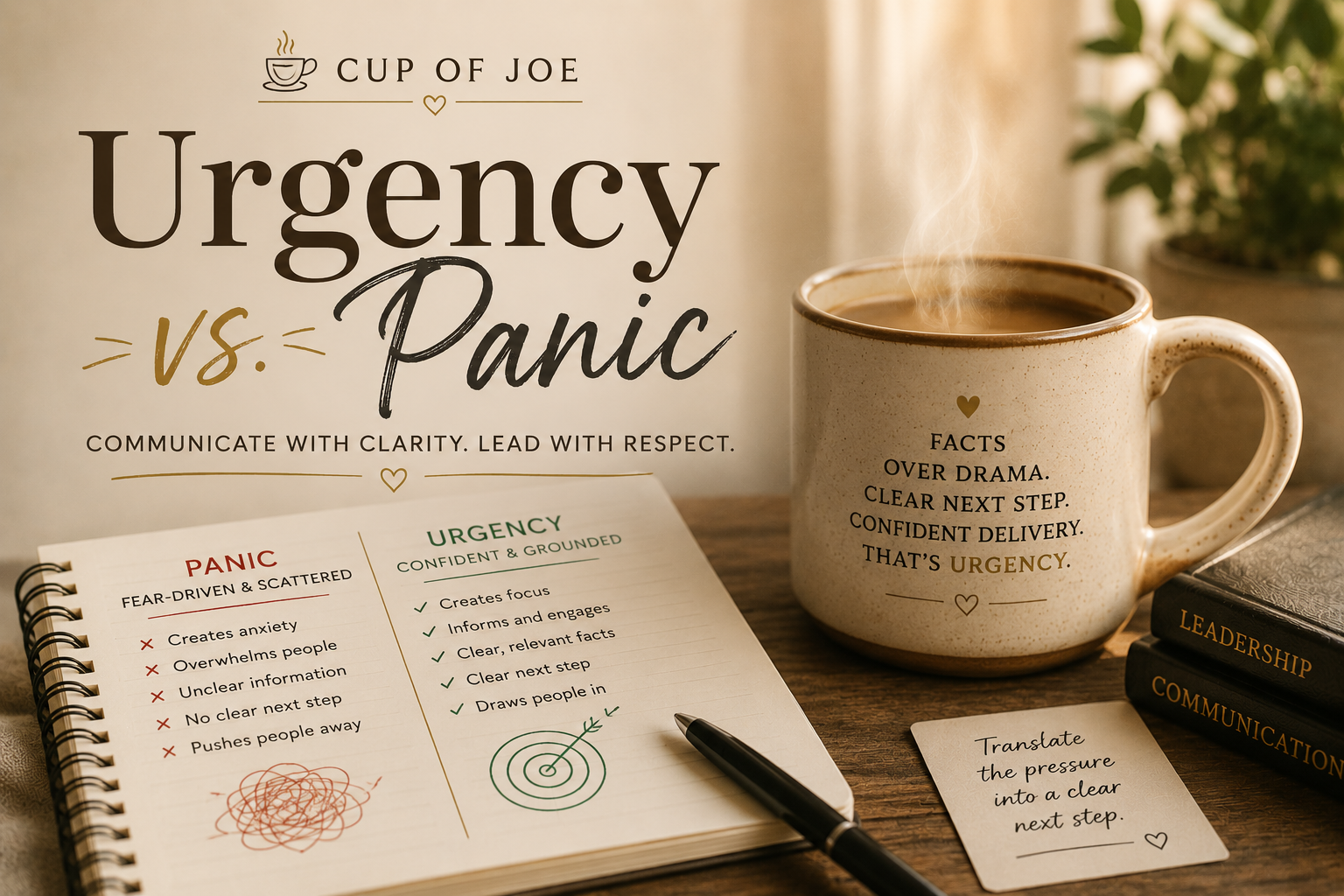
Sense of Urgency
I’ve been reading a book about leadership called, “Who Moved My Pulpit” by Thom S. Rainer, and one of the thoughts I read sparked a pretty good question.
“Leaders must execute three major components: “First, you have to lead the congregation to face reality. Then you have to communicate that reality and the steps needed to move forward again and again. Finally, you must communicate with a sense of urgency.”
You must communicate with a “sense of urgency”. Now, for the question that bubbled up in my soul: How do you communicate a sense of urgency without it feeling panicked and desperate? Is it even possible? Let me provide a few thoughts regarding this thought provoking question.
Urgency and panic feel similar but land quite differently. Here’s a distinction:
Urgency is confident. Panic is fearful.
Urgency says “this matters and here’s why” and panic says “I’m afraid of what happens if this doesn’t work.” The first pulls people in; the second pushes them away. So let me provide a few simple principles to remember.
Be specific, not dramatic. “We have 48 hours before the window closes” hits harder than “we’re running out of time!” Specificity signals you’re in control of the facts. Vagueness signals anxiety.
Lead with stakes, not speed. Don’t ask people to move fast but rather show them what they stand to gain or lose. Speed is the result of understanding stakes, not a demand you make.
Stay calm in your delivery. This one will take some practice. Nothing undercuts urgency faster than a shaky voice or scattered thinking. The more important the moment, the slower and cleaner your communication should be. Deliberate pacing actually amplifies urgency because it says “I’m serious, not scrambling.”
Give people something to do. Panic overwhelms; urgency focuses. Always convert urgency into a clear, specific next action. “Here’s exactly what needs to happen in the next 24 hours” is empowering. Vague alarm is just stress.
Avoid superlatives and absolutes. “This is the most critical thing ever” sounds like crying wolf. Frame it like this- “this is a one-week window we won’t get back” . That is far more compelling.
The underlying principle: urgency is a form of respect. You’re telling someone their time and attention matter right now, and you’ve done the thinking to make that claim credible. Panic is the opposite — it’s asking people to absorb your anxiety rather than act on information.
So, you can be a great leader and carry a sense of urgency. The key is to lead with facts over drama, stay calm and deliberate in your delivery, and always translate the pressure into a clear next step. Done right, urgency isn’t just a communication tactic. It’s a form of respect, and the people you’re trying to move will feel the difference.